
Warehouse Platform Trucks: What Matters for Daily Material Handling?
Quick Answer
A warehouse platform truck should be selected around the goods being moved and the route it follows every day.
The most important factors are the size and shape of the load, platform dimensions, side support, caster configuration, floor condition and available turning space.
A larger deck may reduce the number of trips, but it can also make the trolley harder to manoeuvre. The best choice is the truck that works efficiently throughout the complete handling route.
What Is a Warehouse Platform Truck?
A platform truck is a wheeled material handling cart used for moving cartons, tools, panels, packaged goods and other materials over short distances.
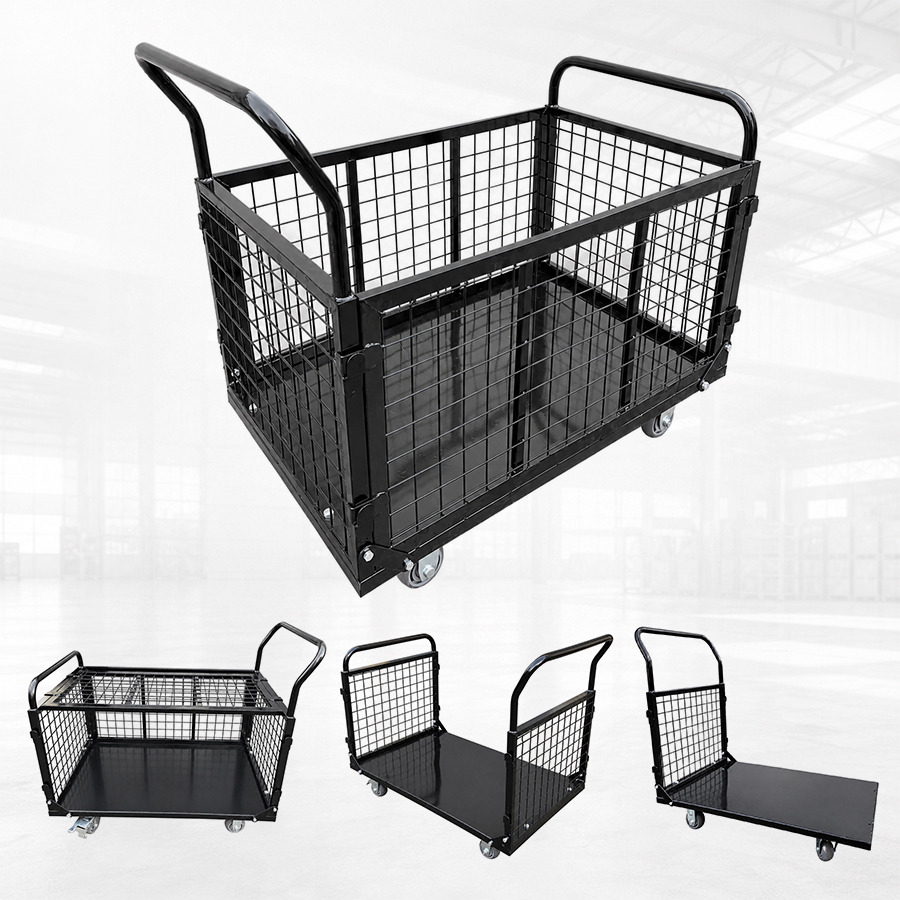
Depending on the application, the loading area can be completely open or fitted with side rails or folding panels.
Our platform trucks for material handling include different structures for warehouse, workshop and production use.
The right structure depends more on what is being moved than on the appearance of the trolley.
Start With the Material
A useful platform truck selection starts with the load itself.
Large sheet materials need a different structure from cartons, tools or smaller packaged products. Long products may benefit from side support, while mixed warehouse goods may be easier to control inside a cart with folding side panels.
The typical quantity moved on each trip also matters.
If the cart usually carries one large item, an open platform may provide easier loading. Where multiple smaller items are moved together, some form of side containment may be more practical.
Platform Size and Manoeuvrability
A larger platform provides more usable deck area, but it also requires more room to turn and park.
This becomes important in real warehouse routes, where a trolley may move through doorways, around workstations, past rack ends and between loading or packing areas.
The narrowest part of the route is often more important than the width of the main warehouse aisle.
For this reason, platform dimensions should be considered together with turning space and operator control.
A truck that technically fits through the warehouse but needs constant repositioning may be larger than the operation actually requires.
When Are Side Rails or Folding Panels Useful?
Side rails can provide additional support for tall, long or irregular materials.
They are particularly useful where a load could shift sideways during movement but still needs to remain accessible for loading and unloading.
Folding side panels solve a slightly different problem. They provide more containment for cartons or mixed warehouse goods while allowing one or more sides to be opened when required.
The choice between an open platform, side rails and folding panels should therefore follow the load shape and handling process.
Why Casters Matter
Caster selection has a major influence on how a platform trolley feels once it is loaded.
Wheel diameter, wheel material and the arrangement of swivel and fixed casters all affect steering and movement.
Floor condition matters as well. Small joints, uneven areas or debris can make a trolley harder to push, especially when the load increases.
Larger wheels can generally pass over small floor irregularities more easily, while smaller wheels may help maintain a lower platform height.
The correct caster arrangement should balance manoeuvrability, control and the actual working surface.
Consider the Entire Handling Route
A platform truck is rarely used only between two open areas.
In daily operation, it may move from receiving to temporary storage, then through picking or production areas before reaching packing or dispatch.
Each stage can introduce different space and handling requirements.
The trolley may need to turn near machinery, pass through a doorway, stop beside a workstation or approach a loading area.
Looking at the complete route helps determine whether additional deck space is genuinely useful or whether a more compact trolley would work better.
This is also why one large cart is not automatically better than several smaller carts. The correct arrangement depends on how the goods are divided and where they need to go.
Platform Truck or Pallet Jack?
A pallet jack and a platform truck are designed for different types of material movement.
Pallet jacks are mainly used for goods already placed on pallets. Platform trucks are often more practical for loose cartons, tools, panels or mixed products that need to move in smaller batches.
Both may be used in the same warehouse.
A pallet jack can move a full pallet between storage areas, while a platform trolley supports shorter transfers between picking, packing and working stations.
For other wheeled handling equipment, see Trolley & Dolly.
What Should Be Confirmed Before Ordering?
The most useful information is the type and maximum dimensions of the goods, the preferred platform size and the normal handling route.
It also helps to explain whether the load needs side support, what the warehouse floor is like and whether there are narrow doorways or turning areas along the route.
Photos of the goods and actual working area can provide useful context when selecting the platform and caster structure.
FAQ
What is a warehouse platform truck used for?
It is used for short-distance movement of cartons, tools, panels, packaged products and other materials inside warehouses, workshops and production areas.
How should I choose the platform size?
Start with the goods, then check the available turning space and the narrowest parts of the handling route. A larger deck is useful only when it remains practical during daily operation.
Are larger caster wheels always better?
Not always. Larger wheels can move more easily over small floor irregularities, but deck height, load type, steering and floor condition should all be considered.
When should a platform truck have side rails?
Side rails are useful for long, tall or irregular goods that need lateral support while remaining easy to load.
Platform truck or platform trolley — is there a difference?
The terms are often used for similar wheeled material handling equipment. The actual platform, side structure, casters and intended load are more important than the name.
Choosing a Platform Truck for Daily Use
A practical platform truck should match the load, floor condition and complete handling route rather than simply offering the largest possible deck.
If you have product dimensions, photos or a typical handling route, you can share them through Contact Us to help confirm a suitable platform truck structure.
Post time: Aug-24-2026


