
Mesh Sides vs Sheet Sides: Choosing the Right Storage Cage
Quick Answer
Start with the smallest item you need to store.
If small or narrow parts could pass through the openings, sheet sides or a sheet base are usually the safer choice. If the goods are large enough to stay securely inside the cage and operators need to see the contents quickly, mesh sides are often more practical.
The side and base do not have to use the same structure. A mesh-sided cage with a sheet base, for example, can keep the contents visible while providing a continuous surface underneath smaller parts.
The right configuration should follow the goods and daily handling process rather than appearance.
Start With the Goods Inside the Cage
The first thing to check is not whether mesh or sheet looks better. It is the size and shape of the products being stored.
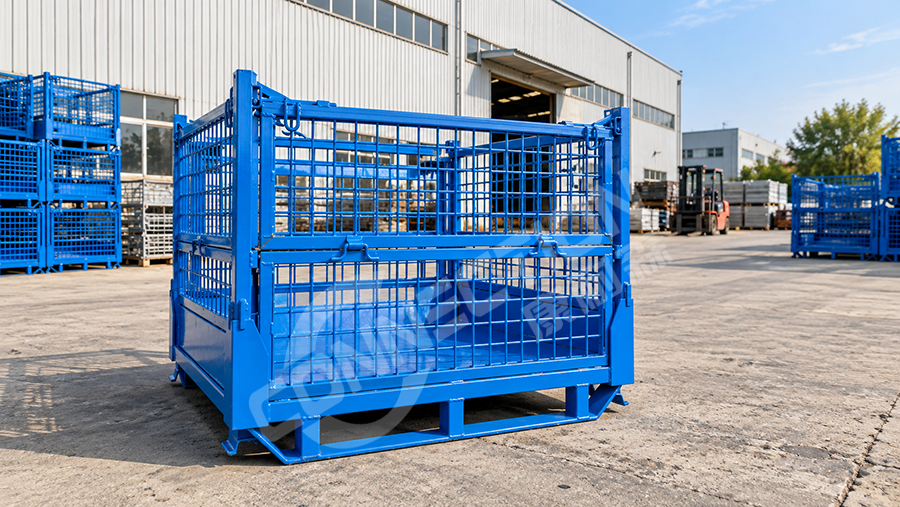
Large packaged components, castings or bulky industrial parts may sit securely inside a mesh-sided steel storage cage. Operators can identify the contents from outside, which is useful when several cages are stored together.
Small fasteners, narrow components or loose parts create a different problem. If they can pass through the mesh, become trapped in the openings or project outside the cage during movement, a sheet-sided structure is usually more practical.
This is especially important where cages move regularly between production and storage areas. A configuration that works while stationary may become less suitable once the cage is handled by forklift or pallet truck.
When Mesh Sides Work Well
Mesh sides are useful when visibility matters.
Warehouse and production staff can see the contents without opening the cage, making it easier to identify parts and check stock during normal handling.
They also suit larger goods that do not need a fully closed side wall. For these products, a mesh structure can provide enough containment without making the cage unnecessarily enclosed.
The key question is whether the smallest item in the cage remains securely inside during loading, movement and stacking.
If the answer is yes, mesh sides are often a straightforward choice.
When Sheet Sides Are More Practical
Sheet sides become more useful when containment is the priority.
For small parts or loose components, a continuous steel surface prevents pieces from extending through the side openings. This can make the cage easier to manage when goods are handled in bulk rather than individually packed.
Sheet sides can also be useful where the stored products have irregular shapes that do not sit neatly against an open mesh structure.
Connection Steel also has configurations using sheet-sided structures for this type of storage requirement.
The trade-off is visibility. With solid sides, operators cannot see the full contents as easily, so gate access and product identification become more important.
Do Not Overlook the Base
For many buyers, the base matters just as much as the sides.
The goods sit directly on it, so the smallest contact area should be checked carefully.
A mesh base can work well for larger products that sit securely across the openings. A sheet base is usually easier for small, narrow or irregular components because it creates a continuous surface underneath the load.
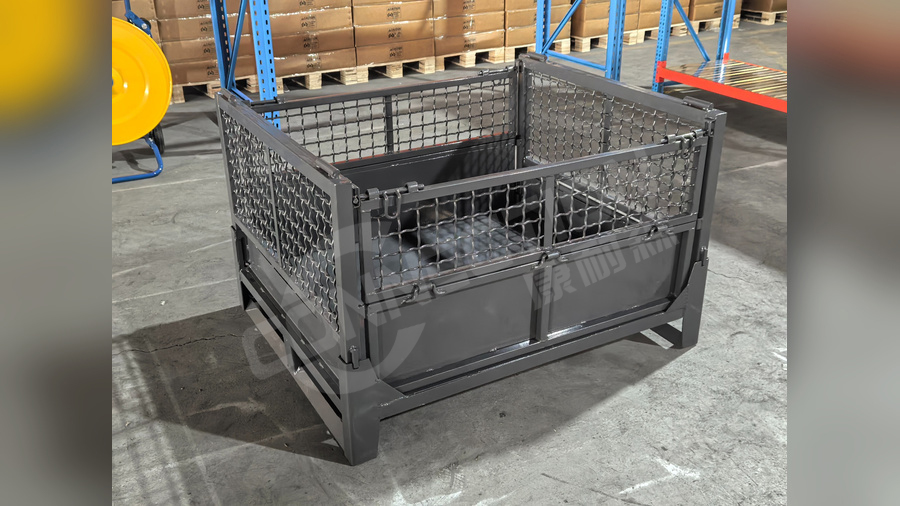
This is why a mixed configuration can be useful. Mesh sides may provide visibility, while a sheet base prevents smaller items from dropping through the bottom.
Some Connection Steel storage cage configurations already use this type of combination.
Gate Access Can Matter More Than the Side Material
A cage can have the right side panels and still be inconvenient if workers cannot reach the goods easily.
Think about how products are actually loaded and removed. If operators pick parts manually, the gate height and opening direction can have a direct effect on daily use.
For deeper or taller cages, front or rear fold-down gates can reduce the need to reach over the side wall or unload products just to access items positioned further inside.
If cages are stacked during storage, it is also worth checking whether the required gate can still be opened in the normal working position.
The side material, base and gate should therefore be considered together.
Check the Handling Method Before Finalizing the Cage
If the cage is moved by forklift or pallet truck, the base design and fork entry are more important than whether the sides are mesh or sheet.
The cage needs to suit the actual handling equipment, aisle conditions and direction of approach.
For operations where the same cage moves between receiving, storage and production areas, avoiding unnecessary transfer between different containers can simplify material flow.
If empty cages are frequently returned or stored after unloading, the folded or collapsed condition should also be checked. For projects where empty cages need to be folded and returned, a collapsible stillage may be more practical than a fixed storage cage. A cage that takes up too much space when empty may create a different warehouse problem even if it works well when loaded.
Which Combination Should You Choose?
|
Storage Condition
|
More Practical Configuration
|
| Large parts that need to stay visible | Mesh sides |
| Small or loose components | Sheet sides |
| Large goods with stable contact points | Mesh base |
| Small or irregular parts | Sheet base |
| Visibility needed but small parts sit on the bottom | Mesh sides + sheet base |
This table is only a starting point. The final choice should still follow the actual product dimensions and handling process.
What Should You Send Before Requesting a Quote?
A photo or drawing of the stored product is often more useful than simply asking for a mesh or sheet cage.
The most useful information is the product size, the smallest loose component, how many pieces go into one cage, how workers load and remove them, and whether the cage will be moved by forklift or pallet truck.
If stacking or empty-cage return is part of the operation, that should also be explained before the cage structure is confirmed.
FAQ
QAre mesh sides suitable for small parts?
Only if the parts are larger than the mesh openings and cannot project through them during handling. For smaller or narrow components, sheet sides may provide better containment.
QCan a storage cage use mesh sides with a sheet base?
Yes. This is a practical combination when operators need to see the contents but smaller items require a continuous bottom surface.
QWhen is a mesh base suitable?
A mesh base works best when the stored goods are large enough to sit securely across the openings without dropping, catching or becoming unstable.
QWhy choose sheet sides instead of mesh sides?
Sheet sides are mainly useful when small, loose or irregular parts need more complete containment.
QShould I choose the side structure before the gate?
They should be considered together. The correct side configuration is less useful if the gate position makes loading or picking difficult.
QWhat matters most when choosing a storage cage?
Start with the actual goods, especially the smallest item, then consider loading access, handling equipment, stacking and empty-cage storage.
Choosing the Right Storage Cage Configuration
The most practical storage cage is the one that fits the goods and daily handling process, not simply the one with the most open or most enclosed structure. To compare more cage structures, visit our warehouse storage cage range.
If you have product dimensions, photos or an existing storage method, you can share them through Contact Us to help confirm a suitable side and base configuration.
Post time: Sep-07-2026


