
Quick Answer
The main difference between detachable and collapsible stacking racks often becomes clear after the goods have been removed.
A detachable structure uses removable posts or frames. It can be broken down into a compact form for empty storage or transport, but the loose components need to be managed.
A collapsible structure keeps the main frame connected and folds down when empty. It is often more convenient when racks regularly move between loaded and empty use.
Neither structure is automatically better. The right choice depends on how the rack is used, how often it becomes empty, and what happens to it between one load and the next.
Detachable and Collapsible Are Structures, Not Applications
A stacking rack is normally selected first according to what needs to be stored.
At Connection Steel, the stacking rack range includes applications such as tyre storage, post pallet storage and fabric roll storage. Within those product groups, different structural designs may be used depending on the handling and storage requirement.
That means “detachable” or “collapsible” does not describe what the rack stores. It describes what happens to the rack when it is not being used.
This is an important distinction when comparing products.
Start With the Empty Rack
When buyers compare stacking racks, the first questions are usually about dimensions, loading requirements and stacking.
Those details matter, but they only describe the rack while it is working.
The more practical question is often:
What happens when the rack becomes empty?
If the rack stays in the same position and is quickly loaded again, the empty condition may not matter very much.
But if dozens of empty racks need to be stored, returned to another area or packed for transport, the structure starts to affect day-to-day warehouse operation.
This is where detachable and collapsible designs behave differently.
When Detachable Structures Work Well
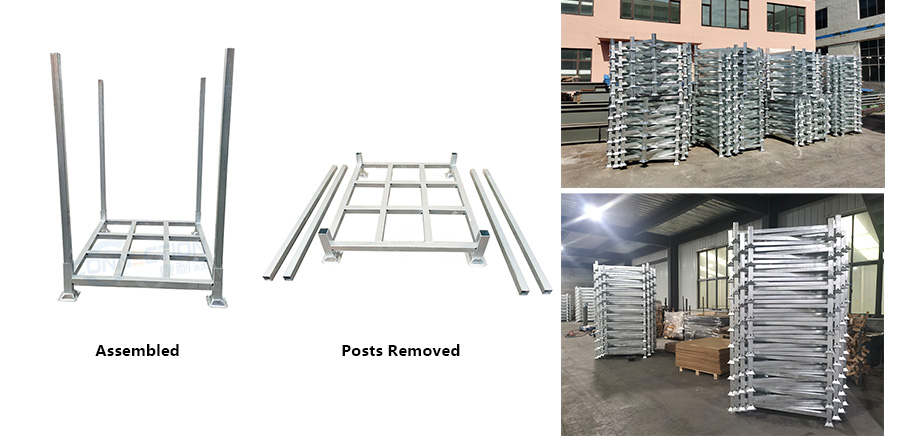
A detachable rack normally allows posts, end frames or similar components to be removed from the base.
Once these parts are taken down, the rack occupies much less vertical space than it does in its working condition.
This can be useful for post pallet stacking rack applications where racks may remain empty for a period of time, or where a large number of units need to be transported in a compact condition.
Detachable designs can also be useful for export orders because the bases and removed structural parts can be arranged more efficiently for packing.
The practical consideration is component management.
When posts are removed, the warehouse needs somewhere to keep them. If several rack sizes or designs are being used, the correct parts also need to stay together.
For a rack that is assembled once and remains in service for a long period, this may not be a problem. If workers need to dismantle and rebuild the rack frequently, the extra handling becomes more noticeable.
When Collapsible Structures Are More Convenient
A collapsible design handles empty storage differently.
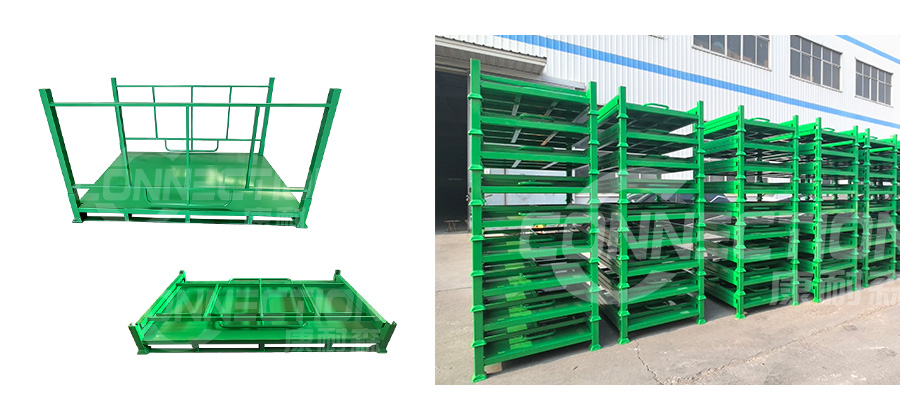
The main structural parts remain connected to the rack and fold down when they are not needed.
This means workers do not have to remove and separately store multiple posts or frames every time the rack becomes empty.
For operations where racks frequently move through a cycle of loaded, empty and loaded again, that can make daily handling simpler.
Some fabric roll storage rack designs use this approach because the rack can be folded when empty and returned to working condition when it is needed again.
The main advantage is not simply that the rack takes up less space. It is that fewer separate components need to be managed during repeated use.
How Often Will the Rack Change Between Full and Empty?
This is one of the most useful questions to ask before choosing the structure.
Imagine two warehouses.
In the first, a rack is assembled, loaded and then remains in service for several months. After the project or storage cycle is finished, the rack is dismantled and put away.
A detachable structure can work very well here.
In the second warehouse, racks are emptied and reused every few days. Workers constantly need to return them to storage and bring them back into service.
In that situation, repeatedly removing and organizing posts may create unnecessary work. A collapsible design may fit the operating cycle better.
So instead of asking only:
“Which one saves more space?”
it is often better to ask:
“How often will we need to change the rack from working condition to empty condition?”
Empty Storage Is Only Part of the Cost
Packed volume is easy to compare because it can be measured.
Handling time is less obvious.
A detachable structure may pack very efficiently, but there is still time involved in removing, sorting and reinstalling components.
A collapsible rack may be quicker to fold and reopen, while its folded dimensions depend on the actual design.
For a small number of racks, the difference may be minor.
For a warehouse operating a large rack fleet, repeated handling can become part of the real operating cost.
This is why purchasing decisions should look at both space and workflow, rather than comparing only the outside dimensions.
What Changes for Export Shipping?
Shipping is another reason to look at the rack in its empty condition.
A fully assembled steel rack contains a large amount of open space. For an overseas order, transporting every unit in its working condition may use container space inefficiently.
Detachable designs reduce this volume by removing posts or frames.
Collapsible designs reduce it by folding the connected frame into a lower profile.
Both approaches can improve packing compared with shipping a fully assembled rack, but the actual result depends on the individual design.
For export projects, it is useful to confirm the assembled dimensions and the packed condition before the order is finalized.
A Simple Way to Compare the Two Structures
|
Actual Operating Condition
|
Structure Worth Considering
|
| Rack stays assembled for long periods | Detachable can work well |
| Empty racks need compact long-term storage | Detachable |
| Container packing is an important consideration | Detachable or collapsible, compare actual packed condition |
| Rack becomes empty and is reused frequently | Collapsible |
| Workers want fewer loose structural parts | Collapsible |
| Different posts and frames can be managed easily | Detachable |
This is a practical starting point rather than a fixed rule. The load, rack size and actual product design still need to be considered.
The Stored Product Still Comes First
Structure should not replace the main product-selection question:
What are you trying to store?
A tyre warehouse, textile warehouse and general industrial warehouse may all use stackable racks, but the rack dimensions and support structure can be very different.
This is why Connection Steel organizes stacking racks mainly by application, including Post Pallet Stacking Rack, Fabric Roll Storage Rack and Tyre Rack, rather than treating detachable and collapsible designs as separate product categories.
Choose the rack application first. Then decide which structure works better for its storage, handling and return cycle.
What Should You Tell the Supplier?
A useful enquiry should explain more than the required outside dimensions.
The supplier needs to understand what will be stored, the approximate load, how the rack will be moved, whether it needs to stack when loaded, and what normally happens when it becomes empty.
For example, a warehouse that needs racks returned empty after every production cycle has a different requirement from a warehouse that leaves the same rack assembled all year.
That operational information can help determine whether detachable, collapsible or another stacking rack structure makes more sense.
FAQ
Is a detachable stacking rack always more compact?
Not necessarily. Detachable designs can reduce empty volume significantly, but the final packed size depends on the rack structure and how the removed components are arranged.
What is the main advantage of a collapsible stacking rack?
The main frame stays connected while the rack is folded, so there are fewer separate components to manage when the rack is repeatedly emptied and reused.
Are detachable and collapsible racks separate stacking rack categories?
They are better understood as structural designs. A tyre rack, fabric roll storage rack or post pallet stacking rack may use detachable, collapsible or other structures depending on the application.
Which structure is better for container shipping?
Both can reduce shipping volume compared with a fully assembled rack. The actual packed dimensions should be compared for the specific rack design.
What should I check before choosing?
Consider the stored product, rack dimensions, load requirement, stacking method, handling equipment, empty-rack storage and how frequently the rack will be assembled, dismantled or folded.
Choose the Structure Around the Way the Rack Is Used
Detachable and collapsible stacking racks solve the same basic problem in different ways: reducing the space taken by an empty rack.
The right choice depends on what happens after the load leaves the rack.
If the rack will remain empty for a long period or needs compact packing for transport, a detachable structure may be a good fit. If it is emptied and reused frequently and workers want to avoid managing loose posts or frames, a collapsible design may be more convenient.
If you already know what you need to store, the rack quantity and your handling process, share the details through Contact Us. Shandong Connection can help review the suitable stacking rack type and structure.
Post time: Oct-08-2026


