
Quick Answer
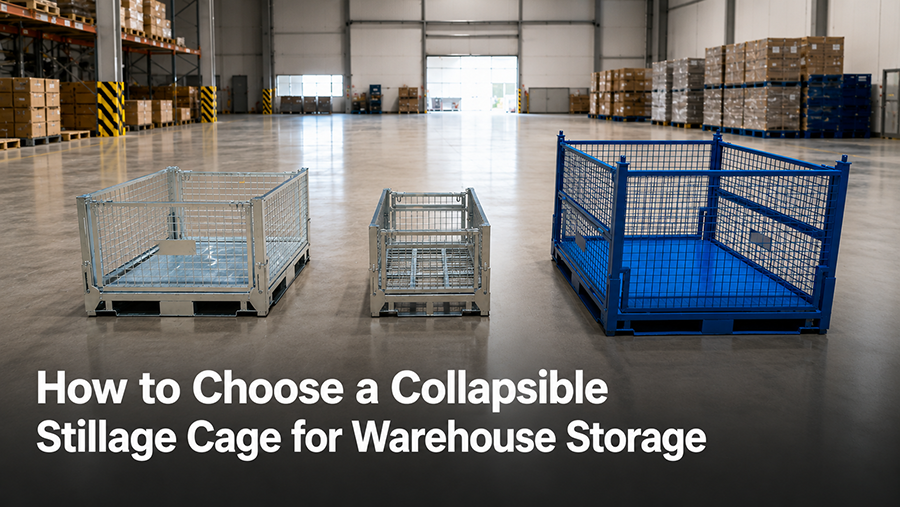
A collapsible stillage cage should be selected according to the goods being stored, required cage size, load capacity, stacking method, forklift handling and warehouse environment.
For most warehouse projects, buyers should check the internal usable space, folded height, base structure, gate design, mesh size and surface treatment before placing an order. A suitable cage should protect the goods, support daily handling and reduce empty storage space when folded.
What Is a Collapsible Stillage Cage?
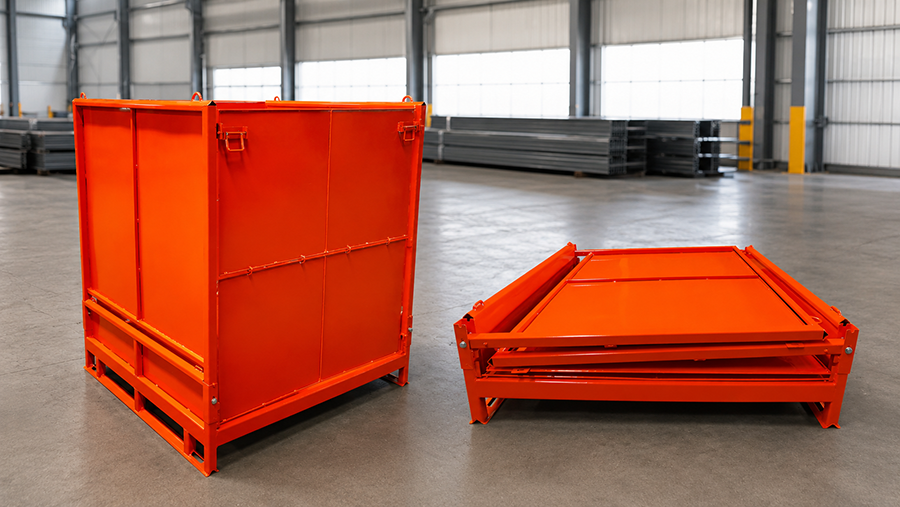
A collapsible stillage cage is a steel storage container used for warehouse storage, material handling and transport. Unlike a fixed steel cage, it can be folded or collapsed when empty, helping reduce the space needed for storage or return transport.
It is commonly used in manufacturing plants, logistics centers, automotive parts warehouses, retail distribution, industrial component storage and reusable packaging systems.
Compared with a standard pallet, a collapsible storage cage provides side protection for loose, boxed or irregular goods. Compared with a fixed cage, it offers more flexibility when empty cages need to be stored or returned.
For buyers looking for reusable warehouse containers, a collapsible stillage cage can be a practical option when both storage protection and space saving are important.
1. Start with the Goods You Need to Store
The first step is to understand what will be stored inside the cage. Different goods require different cage structures.
| Stored Goods | Main Consideration |
|---|---|
| Loose parts | Mesh size, side protection and bottom support |
| Boxed goods | Internal dimensions and loading clearance |
| Automotive parts | Product shape, surface protection and access method |
| Metal components | Load distribution and base reinforcement |
| Returned goods | Folding frequency and easy handling |
| Export goods | Folded size and container loading efficiency |
Before choosing a cage, buyers should confirm the product size, weight, quantity per cage and whether the goods need full side protection.
For small parts, the mesh opening should be suitable enough to prevent goods from falling out. For heavier goods, the base frame and load distribution should be checked carefully. If the goods need to be accessed frequently, a front gate or half-drop gate can make loading and unloading easier.
2. Confirm Cage Size and Folded Height
Cage size should not be selected only by external dimensions. Internal usable space is just as important.
The internal length, width and height determine how much product can be loaded. The external size affects warehouse layout, stacking position, forklift operation and container loading.
| Item to Check | Why It Matters |
|---|---|
| Internal size | Determines actual loading space |
| External size | Affects warehouse layout and transport |
| Folded height | Affects empty cage storage |
| Gate opening | Affects loading and unloading |
| Fork entry height | Affects forklift or pallet-jack handling |
| Mesh size | Affects protection for small parts |
The cage should allow enough clearance for practical loading. If the space is too tight, workers may find it difficult to load or remove goods. If the cage is much larger than the goods, warehouse space and transport cost may be wasted.
For export orders, folded height and container loading quantity should be considered before production.
3. Check Load Capacity and Stacking Requirements
Load capacity is one of the most important purchasing points, but it should be confirmed based on actual goods and handling conditions.
A general description such as "heavy duty storage cage" is not enough. Buyers should confirm:
- Total load per cage
- Load distribution
- Whether the cage will be stacked when loaded
- Required stacking levels
- Floor condition
- Forklift handling frequency
- Indoor or outdoor use
The load capacity of a collapsible stillage cage depends on the steel structure, base frame, mesh panel, post design, welding structure and stacking points.
A cage may have a rated load under normal conditions, but safe stacking also depends on cage alignment, floor flatness, goods stability and total stacked height. The suitable stacking method should be confirmed for each design.
4. Choose the Right Gate and Access Design
The gate design affects how easily goods can be loaded and removed.
| Gate Type | Suitable Use |
|---|---|
| Front drop gate | Easier access when goods are inside the cage |
| Front and back gate | Loading or unloading from both sides |
| Half-drop gate | Accessing lower goods more easily |
| Full open side | Larger goods or special loading needs |
| Lockable gate | Better containment for selected applications |
A front drop gate is useful when goods need to be accessed without fully unloading the cage. For warehouses that load from different directions, front and back gates may be more convenient.
For loose or small parts, the gate should close securely and match the mesh or side frame structure.
5. Confirm Forklift and Pallet-Jack Handling
Most collapsible stillage cages are designed for forklift handling, but the actual handling method should still be confirmed before production.
Important details include:
- Fork entry direction
- Fork pocket or base clearance
- Pallet-jack compatibility
- Whether the cage will be moved while fully loaded
- Warehouse aisle width
- Loading direction
- Required ground clearance
A product described as "forklift accessible" may still need adjustment if the warehouse uses a specific forklift, pallet jack or handling process.
If the cage will be moved while loaded, the base frame, fork entry area and load distribution should be reviewed carefully.
6. Select a Suitable Surface Treatment
Surface treatment should match the operating environment.
| Surface Treatment | Typical Use |
|---|---|
| Powder coating | General indoor warehouse and factory use |
| Zinc plated finish | Selected parts or light corrosion protection needs |
| Hot-dip galvanizing | Outdoor, humid or more corrosive environments |
Powder coating is commonly used for indoor warehouse storage cages. It provides a clean appearance and can be supplied in different colors.
Hot-dip galvanizing may be considered for outdoor or humid environments, but it is not required for every project. The final choice should depend on the working environment, corrosion risk, appearance requirement and budget.
7. When Is a Collapsible Stillage Cage a Good Choice?
A collapsible stillage cage may be suitable when:
- Goods need side protection during storage or transport
- Empty cages need to be folded for storage
- Return transport volume needs to be reduced
- Goods are handled by forklift or pallet jack
- Warehouse inventory changes frequently
- Loose or boxed goods need better containment than a pallet
- Reusable steel containers are required for repeated handling
It may not be the best choice for very long goods, open-side loading, or products that require a rack-style structure. In these cases, custom stacking racks or steel pallets may be more suitable.
Buyers can also compare different warehouse storage cages according to their goods and handling process.
Information Needed for a Custom Quote
To receive a clearer quotation, prepare the following information:
- Product name and photos
- Product dimensions and weight
- Quantity stored in each cage
- Required cage size
- Required load capacity
- Required stacking levels
- Gate or door requirement
- Mesh size preference
- Forklift or pallet-jack information
- Indoor or outdoor use
- Surface treatment requirement
- Order quantity
- Destination country or port
A simple drawing is helpful for confirming the cage size, gate position, base structure, mesh panel and folding direction before production.
FAQ
What is a collapsible stillage cage used for?
It is used for warehouse storage, material handling, transport and returnable packaging. Common applications include loose parts, boxed goods, automotive components and industrial products.
What is the difference between a collapsible stillage cage and a storage cage?
A collapsible stillage cage is a type of storage cage that can be folded when empty. A general storage cage may be fixed, detachable, pallet-based or collapsible.
How do I choose the right cage size?
Start with the product dimensions, loading quantity and required clearance. Then confirm internal size, external size, folded height, gate opening and forklift access.
Can collapsible stillage cages be stacked?
Many collapsible cages can be stacked, but the safe stacking level depends on load, cage structure, floor condition and operating environment. It should be confirmed for each project.
Can the cage be customized?
Yes. Cage size, load capacity, mesh size, base structure, gate design, surface treatment, color and identification markings can be customized according to project requirements.
Request a Custom Collapsible Stillage Cage Solution
A suitable collapsible stillage cage should match the goods, load, warehouse layout, handling equipment and storage environment. It should also consider folded storage, return transport and daily loading efficiency.
Send us your product size, weight, loading quantity, required stacking levels and handling method. We can review the information and discuss a suitable cage structure and specification.
Post time: Jul-01-2026


